“In the oasis complex, the thirsty man imagines he sees water, palm trees, and shade not because he has evidence for the belief, but because he has a need for it. Desperate needs bring about a hallucination of their solution… The oasis complex is never a complete delusion: the man in the desert does see something on the horizon. It is just that the palms have withered, the well is dry, and the place is infected with locusts.”
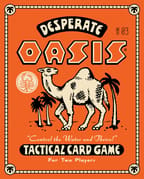
I bought Desperate Oasis because of an ad. I’d like to say there was more to it than that, that I’d read a review or heard it recommended by someone whose taste I trust, but the honest version is that I was scrolling on BGG (I may have an issue with the Fall VFM next month), the ad came up with its vintage styled art of camels and meerkats, and something in me decided I needed it before any other part of me had a vote. Honestly the camel on the box screamed the cigarette brand to me! It was small and cheap and promised 15 minutes of two friends fighting over a watering hole. I ordered it in about the time it takes to read this sentence.
I’ve thought about that moment more than a card game probably deserves, mostly because of how familiar it felt. Anyone with a shelf like mine knows the feeling. There’s a gap you can’t quite name, a Tuesday night with nothing on it, a stretch where the usual games feel worn smooth, and then something on the horizon shimmers and you’re sure that’s the thing that will fix it. You don’t have evidence. You have a thirst, and the thirst is very good at drawing pictures.
What makes de Botton’s line stick with me is the second half, the part people tend to skip. The man in the desert isn’t inventing the oasis out of nothing. There really is something out there. It’s just that the version he sees is the version he needs, green and full and waiting for him, and the version that actually exists has dry wells and locusts. The hope isn’t false so much as over furnished.
The game, as it turns out, is built on exactly that.
You and your opponent sit across from a row of oasis cards, and each one is its own little contest. You play animals beneath them, building up strength, trying to claim each oasis at the end of the round. Camels, jackals, elephants, each with some small ability that shoves the board around. Play an animal next to another of its kind and they pull together and shift, so the table never sits still for long. There are palm tree tokens you can spend to give an animal a boost when it matters, and the temptation is always to spend them too early, which I did, more than once.
Then there’s the detail that made me laugh out loud the first time I understood it. Some of the oases are worth negative points. You can fight hard for one, outplay your opponent, stack your best animals around it, and win it, and what you’ve won is a dry well. The game lets you chase a mirage with real conviction and then hands you the locusts.
I think that’s the cleverest thing about it, and the most honest. Most games reward wanting things. You see the prize, you go after it, you get it, and getting it feels good. Desperate Oasis asks you to look twice at every glimmer on the horizon before you commit your camels. It asks whether you want this oasis because it’s good, or because it’s there and you’re thirsty and the other player looks like they want it too. Those are different reasons, and the scoring knows the difference even when you don’t.
There’s a version of this post where I talk myself out of the purchase in hindsight, where the ad becomes a little parable about impulse and the marketing machine and how easily we’re sold water that isn’t there. I don’t feel that way about it though. The game is good. It’s quick and sharp and a little mean in the right places, and it slips into a bag without taking up any space. Whatever I was thirsty for that night, I did find something on the horizon.
I just didn’t find exactly what I’d pictured, which is how it usually goes. I imagined a lighthearted filler about cute animals. What I got was a small, pointed lesson in checking the well before you drink, wrapped in a game about animals. That’s a better deal than the ad promised, honestly. The palms weren’t withered, but they weren’t the palms I’d drawn in my head either.
I keep coming back to how much of this hobby lives in that gap between the oasis we imagine and the one that’s actually there. Every new box on the shelf started as a shimmer somewhere. Some of them turned out to be dry. A few turned out to be better than the mirage. Most landed somewhere in the middle, real and worth having, just a little more ordinary up close.
Last night in my playthrough the cards were still out on the table after the game ended, the oasis row in a crooked line, and one of them was the negative one I’d fought hardest for. A chameleon and two camels were still huddled under it, very proud of themselves, guarding a well with nothing in it.
 Pondscape
 Space Base