 Solid
Magical Athlete Review
7/ 10- Played 3 times on this shelf
- 2–6 players · best at 6
- 30 min
- Light
I keep coming back to something small about Magical Athlete that I didn't expect to think about this much: it doesn't care who's sitting at the table. I've played it with people I met an hour earlier at a game night, names still not quite locked into memory, and I've played it with my own grown kids, the ones who used to fall asleep in the middle of Candy Land and now have opinions about worker placement. Both times, everyone was howling by the third lap. Same volume of laughter, same disbelief at the last-second reversal, same person groaning because their guy tripped over his own cape. That kind of consistency is rare enough that it made me pay attention to why.
Part of it is obviously the roster. Every racer in this game is a joke wearing a hat, and the joke is the point. You're not picking a character because you've studied a meta or optimized a build. You're picking one because the name made you laugh, or because the ability sounded chaotic enough to be worth the risk, and then you find out what that ability actually does at the worst possible moment for somebody else at the table. I think that's closer to how most of us actually choose things in life than we admit. Not analysis. A gut pull toward the thing that seems fun to be, consequences unknown.
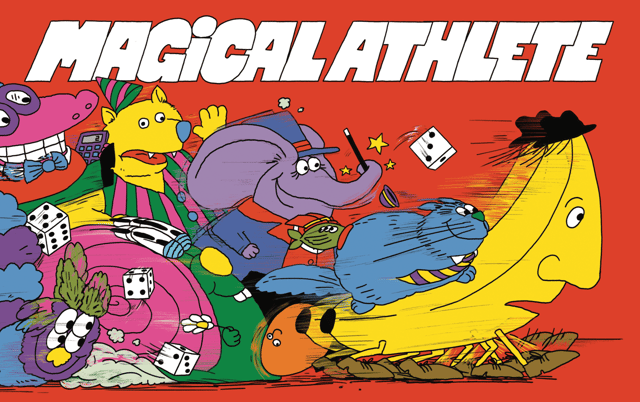
It reminded me, more than once, of Wacky Races. Not in any official way, nobody licensed anything, but in spirit. That cartoon understood that a race is more interesting as a personality contest than a physics problem. Dick Dastardly wasn't going to win on speed. He was going to win, or more often lose spectacularly, on scheme. Magical Athlete has that same energy sewn into its bones. The board is almost beside the point. The race is just the excuse for a parade of little disasters and reversals, each one attached to a character who has already told you, through nothing but their name and their portrait, exactly what kind of trouble they're going to cause.
What I keep sitting with is how little all of that costs. Not just in dollars, though it is genuinely inexpensive as these things go, especially set against games that ask fifty or eighty dollars for a box of minis you'll paint twice and never touch again. I mean the cost in effort. There's no learning curve worth mentioning. Nobody at the table needs sixty hours logged to have a real chance. You explain it in five minutes and you're rolling dice and laughing at strangers or family within ten. Somewhere in there is a real point about what we've decided games are supposed to be worth, and how much of that supposed value is actually just production cost dressed up as depth. A cheap box of cardboard racers can hand you more genuine, shared laughter in forty minutes than plenty of games three times its price manage in three hours.
I don't think I'd call it a deep game, and I don't think it wants to be one. What it is, is honest about what it's for. It wants a table full of people, strangers or blood, laughing at the same dumb collapse of a plan nobody had in the first place. I've had that exact laugh happen with people I'd just met and with kids I raised, on the same board, over the same silly last-second reversal, and there's something almost touching about a game cheap enough to buy on a whim that turns out to be that reliable a container for joy. You could spend ten times the money chasing that feeling and not find it half as often.