 Situational
There is a particular kind of figurine that lived on the shelves of a certain generation of grandmothers. You know the ones. Soft pastel paint, enormous eyes, a head tilted at an angle meant to break your heart a little, each one sealed behind the glass of a curio cabinet that nobody under the age of forty was allowed to open. Precious Moments, mostly, though the category was wider than the brand. They were made to be looked at and never touched, which is probably why every child who ever visited that house wanted nothing more than to pick one up.
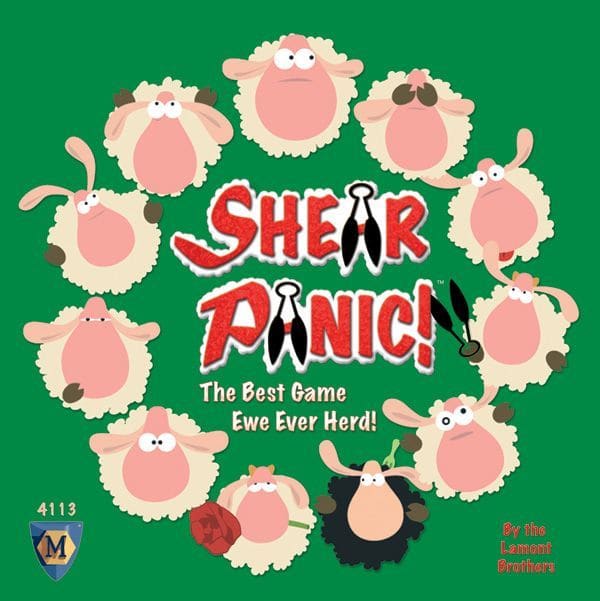
Shear Panic hands you nine of them and tells you to shove them around a field. That is the first thing anyone notices about this game, and for a lot of people it is the only thing they remember. It came out in 2005 from Fragor Games, the Scottish studio run by the Lamont brothers, Gordon and Frazer, and later got a Mayfair edition. The sheep are small painted figures mounted on bases, a tight little flock of them, each one with the kind of face and posture that belongs on a greeting card. One reviewer compared them to Christmas tree ornaments, which gets close. My own first thought was the curio cabinet. There is a ram named Roger, a sheep shearer who stands at one end of the board looking entirely too pleased with himself, and a single black sheep sitting in the middle of everyone else like a family secret.
I played this a lot with the kiddos when they were early teens, and we all had tons of fun with it. That might be the ideal age for Shear Panic, old enough to care about the timing puzzle and young enough to enjoy a game whose whole point is shoving everybody's sheep toward a man with clippers. When I think about these figures now, what comes to mind is less a curio cabinet than the whole flock crammed together in the middle of our table.
The flock starts as a three by three square. Each player owns a couple of sheep in their color, and the black sheep belongs to nobody, sitting in the center. That is the whole board state, nine figures crowded together, and every move in the game is some way of rearranging that crowd.
Each player has a small mat of actions, each of which can be used exactly once. The names are the sort of puns you either love or tolerate. Lamb Slam moves one sheep. Line Push shoves an entire row or column along. Diagonal Push does the same thing at an angle. Wool Rule squares up the edges of the flock. One Small Step nudges a single sheep into an empty space. Booiinggggg jumps a sheep over another. Ewe Turn rotates the entire flock ninety degrees, which is as disorienting on the table as it sounds. Because the flock is so small and so tightly packed, nearly every action moves somebody else's sheep along with yours. There is no private space in Shear Panic. You cannot build anything on your own side of the table, because there is no side of the table. There is only the huddle, and your two little figures are somewhere in it, being jostled.
What keeps this from being a pleasant bit of shuffling is the timer track. Every action has a number printed on it, and when you take it, a marker moves that many spaces along the track. Certain spaces trigger scoring, and which kind of scoring happens depends on which of four fields the marker has reached.
In the first field, Team Tag, you score for your own sheep touching each other, more for sides than for corners. In Roger's field, the rows closest to the ram are worth the most, so everyone is suddenly trying to press their sheep toward the handsome fellow at the edge of the board. In the Black Sheep field, the points come from touching the black sheep, and the little outcast in the middle becomes the most popular animal in the flock. Then comes the Shear Panic field itself, where the row nearest the shearer is removed from the game entirely and scores nothing, and the survivors score more the farther they managed to get from the clippers.
The numbers on the actions are where the real game lives. A strong move that also shoves the timer a long way forward might trigger a scoring round before your opponents can respond, or it might drag the whole flock into the next field before you were ready. A small move buys you position without spending much time. Since each action can only be used once, you are also always doing a quiet inventory of what everyone else has left. Holding on to the right action until the last scoring round matters more than almost anything else you can do, and figuring out which one that is takes most of a first game to understand.
Milan Kundera wrote about kitsch in terms of two tears. The first tear is the one you shed at something sweet, children running across a lawn. The second is the tear you shed at how lovely it is to be moved by children running across a lawn, together with everyone else who is also being moved. Kitsch, in his account, lives in that second tear. It is sentiment admiring itself.
The figurines in the curio cabinet were very much second tear objects. Nobody loved them for what they depicted so much as for the feeling of being the sort of person who loved them. What I find so funny about Shear Panic, and I think it is a genuinely sharp piece of design humor, is that it offers you exactly that kind of object and then puts a man with electric clippers at the end of the field. The game invites the first tear, lets you settle into admiring how precious your little sheep are, and then starts the clock.
There is also something in the way the game makes you handle them. A figurine behind glass stays perfect because it never does anything. These sheep get pushed in lines, spun around, bounced over each other and finally sent off the board. They are treated as game pieces in the most practical way possible, and they are more charming for it. A thing that is only looked at has no history. A sheep that survived the Shear Panic field three rows from the shearer has a story, even if it only lasts until the box goes back on the shelf.
Shear Panic is light, quick, and tactical, the kind of game that plays in under an hour and asks you to think about timing more than long plans. It is at its best with people who are willing to laugh at their own sheep getting shoved toward the clippers, which described our table perfectly when the kids were that age, and it is weakest with anyone who wants deep strategy, since the flock changes so much between turns that careful plans rarely survive. The interaction is constant and a little mean, in the friendliest possible way.
It has been out of print for a long time, and copies tend to be priced all over the place on eBay, which is fitting for a game whose pieces look like they came from a curio cabinet. The sheep deserve the reputation. The game underneath them deserves a little more credit than it usually gets for what it does with that timer track.
And somewhere, I like to imagine, there is a grandmother who would have been horrified to see her sheep pushed around a board, and a grandchild who would have finally, gleefully, been allowed to touch one.