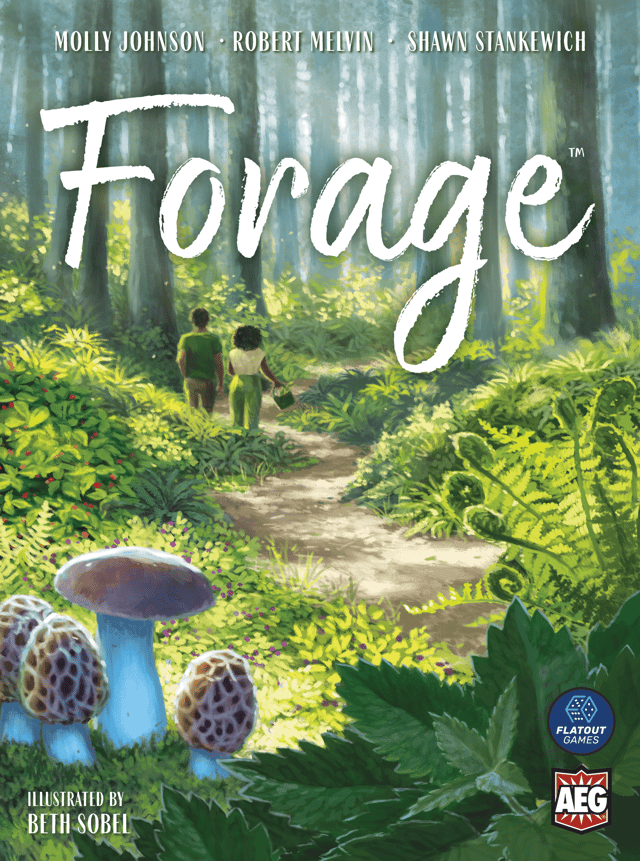
 Solid
Most of the games on my shelf are about accumulating something. Points, territory, cards, victory conditions stacked until one number beats the others. Forage isn't really that, and it took me a session or two to stop expecting it to be.
You spend the game walking through a season, encountering plants and fungi and small signs of the wild one card at a time, and the actual decision in front of you almost never has to do with optimizing anything. It's simpler and harder than that. Do you take this, or do you leave it. Can you actually identify what you're looking at with enough confidence to act on it, or are you better off walking past. The game doesn't punish you the way most games punish a wrong move, with a straightforward loss of points or position. It punishes you the way the woods actually would, quietly, by way of a choice you can't take back once it's made.
What I like about that is how much restraint the game asks of you without ever making restraint feel like the boring option. There's a real pull to take everything in front of you, card after card, because that's what most games have trained me to do with resources. Forage keeps nudging me toward the opposite instinct: take only what you need, only what you're sure of, and let the rest of it stay where it is. That's not a moral I went looking for. It's just what falls out of playing the thing enough times to notice the pattern.
It also plays beautifully alone, which is rare enough on my shelf to be worth saying outright. A lot of games marketed as "great solo" are really just a multiplayer game with the fun parts stripped out. Forage was clearly built to be sat with by yourself, unhurried, closer to a quiet hour than a competitive session.