Everything the Shelf Can Do (and Why I Built It This Way)
2026-09-04
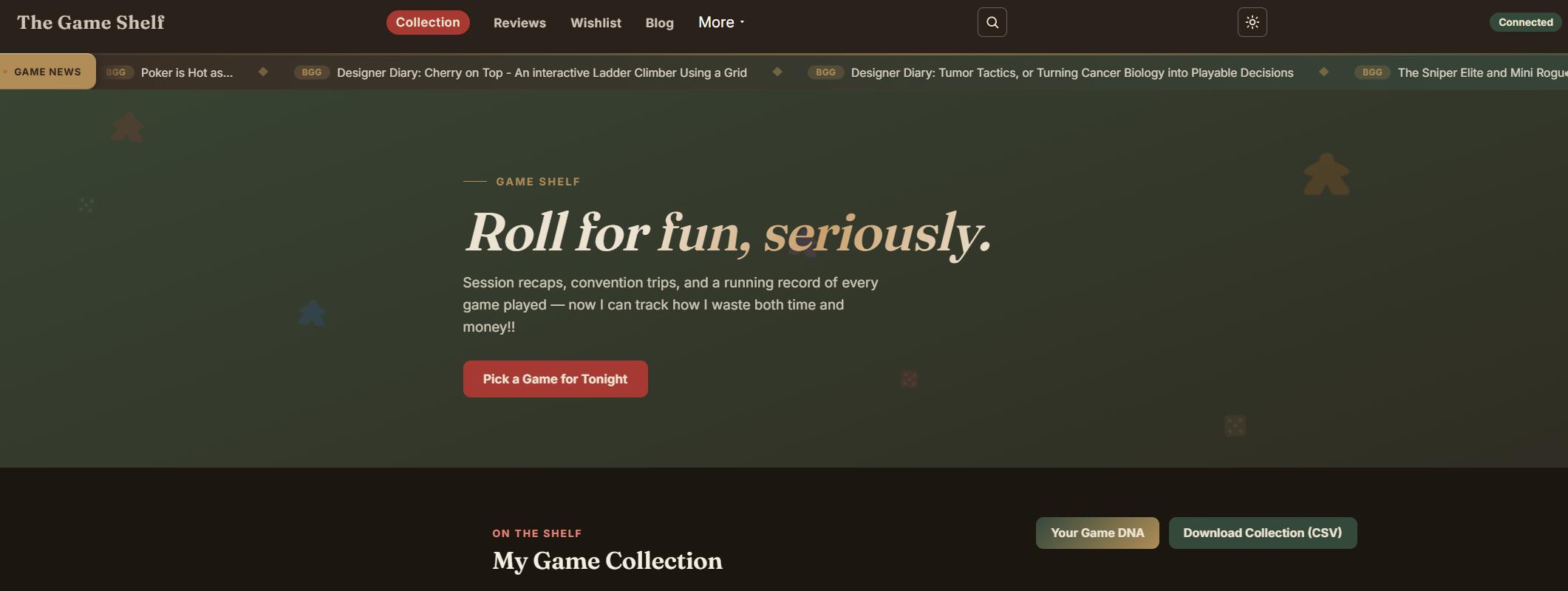
I started this thing as a spreadsheet. An actual spreadsheet, with a tab for "owned" and a tab for "want" and a column where I'd type W or L after a game night and immediately forget to fill it in for three weeks straight. I think most people who track their collection start somewhere like that, and most people stop somewhere like that too, because a spreadsheet doesn't care whether you use it and it definitely doesn't care whether you win. What I actually wanted was something that felt like it belonged to the hobby instead of just cataloguing it from the outside. So, the Game Shelf grew past "list of games I own" pretty fast, and it hasn't really stopped growing since. I want to walk through what's on it now, partly because I think a few of these pieces are genuinely useful if you're trying to keep your own shelf, and partly because writing it all out in one place is the only way I've found to actually see the shape of the thing I've built. The collection itself: The core of it is still what it always was: your games, owned or not, with real cover art and real data pulled straight from BoardGameGeek the moment you search for a title. Type a few letters and it autocompletes against BGG's own database, so you're not hand-typing player counts and playtimes for over six hundred games (and counting since they are not all logged yet). Every game gets a detail view, and the Collection tab is where you actually browse what you have. But I built in a distinction that turned out to matter more than I expected: owned versus played not owned. If you log a session for a game you don't own, or a friend brings something over and you play it, it still gets a real row with cover art and its own page. It just doesn't clutter your Collection grid. There's a small owner-only widget on those playednot owned games asking, essentially, "worth buying?" with a yes, maybe, or no and a spot for notes, so six months later when you're standing in a game store trying to remember if you liked something, the answer's already sitting there. Reviews and a Wishlist live right alongside the collection. Reviews get their own embossed rating medallion now, something I went back and redid more than once because the first version looked like a sticker slapped on a card and I wanted it to look like something you'd actually want to display. Think my review is off; there is an option for you to give your own rating and then the site displays a community badge along with mine. The Wishlist pulls in BGG's live "hot games" list too, so you can see what the rest of the hobby is buzzing about without leaving the page. The part that isn't just about the games: Somewhere in the middle of building this I realized the interesting data isn't really the games. It's who you played them with and what happened. So sessions get logged with real players, and from that everything else about the social side of the site follows. Two people who play the same game against each other build a real head-to-head record, win-loss, and if a trophy gets sent after a session, there's a "belt" for that matchup, whoever holds it currently, right there on the profile. It's a small thing but it changes how a rematch feels. There's a leaderboard now too, ranked properly across everyone tracked in the system, with a genuine record instead of a vague sense of "I think I'm pretty good at this." Accounts are real accounts now, not just me poking at my own data. Anyone can create one, log their own collection and sessions privately, and optionally make a public profile so friends can see their shelf, their stats, their trophy case. You can send and accept friend requests, get a notification when someone sends you one or when a new trophy lands, and there's a lightweight "what should we play?" matcher that looks at two people's owned games and suggests something that actually works for both of you, instead of the usual fifteen minutes of standing in front of the shelf going back and forth. Achievements exist too, and I spent a genuinely embarrassing amount of time on how they look. They're embossed medallions now, a little meeple stamped into brass, locked and matte until you actually earn one and it lights up. I didn't want a row of cartoon badges. I wanted something that looked like it meant something if you'd earned it. Keeping score of the year, not just the game: Every year the site puts together a "Wrapped," a proper recap, most played game, biggest rival, your record, styled and built to be shared as an actual image, not a screenshot of a spreadsheet. Individual sessions can generate their own shareable recap cards too, and there's a full trading-card generator for a game in your collection if you just want something good-looking to post. Yes, it is like Spotify LOL. There's a Game DNA feature that takes your collection and renders it as a radar chart, weight, luck, interaction, strategy, so you can actually see your own taste laid out in a shape instead of just knowing vaguely that you like "medium-heavy euros, mostly." A 10x10 challenge tab tracks the old hobby tradition of picking ten games and really playing them, ten times each, over a year, which is its own kind of interesting once you're a few plays deep into something and start noticing what repetition does to a game you thought you already understood. The practical stuff nobody else seems to bother with: A Game Stores tab lists the local shops I actually trust, with a free map (no Google API key, no billing account, just OpenStreetMap) and a "near me" search that pulls from the same open data instead of some walled garden. There's a Game Night Concierge that takes a plain-language mood, something like "quick and mean, twenty minutes, two players," and picks one real game out of your actual owned collection with a reason, instead of a generic top ten list that assumes you own none of it. And there's Piece ID, which is a little strange to explain but has genuinely saved me real frustration: point a camera at a stray game piece with no idea what it belongs to, and it'll tell you. I built it after losing an afternoon trying to identify a wooden cube that had ended up loose in a box of unrelated tokens. This is one of a number of features that is not available to account holders as there is still a cost to using it and I am working through that. Geez, I am not made of money! A weekly email digest went in most recently, your sessions, your belts won or lost, new friend connections, whatever you posted to the blog or in reviews that week, and even what's trending on BGG right now, all in one actual newsletter instead of a bare notification you have to remember to check for. What I think actually sets it apart: There are plenty of collection trackers out there, and BGG itself does a fine job of being the encyclopedia. What I don't see much of is a shelf that treats the social half of the hobby as seriously as the inventory half. Most tools I've used are built around the assumption that you're cataloguing objects. This one's built around the assumption that the object doesn't matter nearly as much as the night you played it, who you played it with, and whether you'd do it again. I don't know if that's a better philosophy for a board game site or just the one that happens to match how I actually think about the hobby. But every feature on here, the belts, the trophy case, the DNA chart, the digest that lands in your inbox on a Sunday morning, came from wanting to remember something specific about a specific night, not just wanting a prettier list. It's still growing. There's a stack of half-formed ideas sitting in a doc, game night scheduling, photo galleries on sessions, a few things I'm not ready to talk about yet. For now, though, this is what's live, and most of it started because I got tired of a spreadsheet that didn't know or care whether I'd actually won. By Norman, BigGame, BGG Tabletop. Photography. Philosophy. The spaces where they all live.