Rainbow Blvd.: Don't Judge This One by Its Cover
2026-07-27
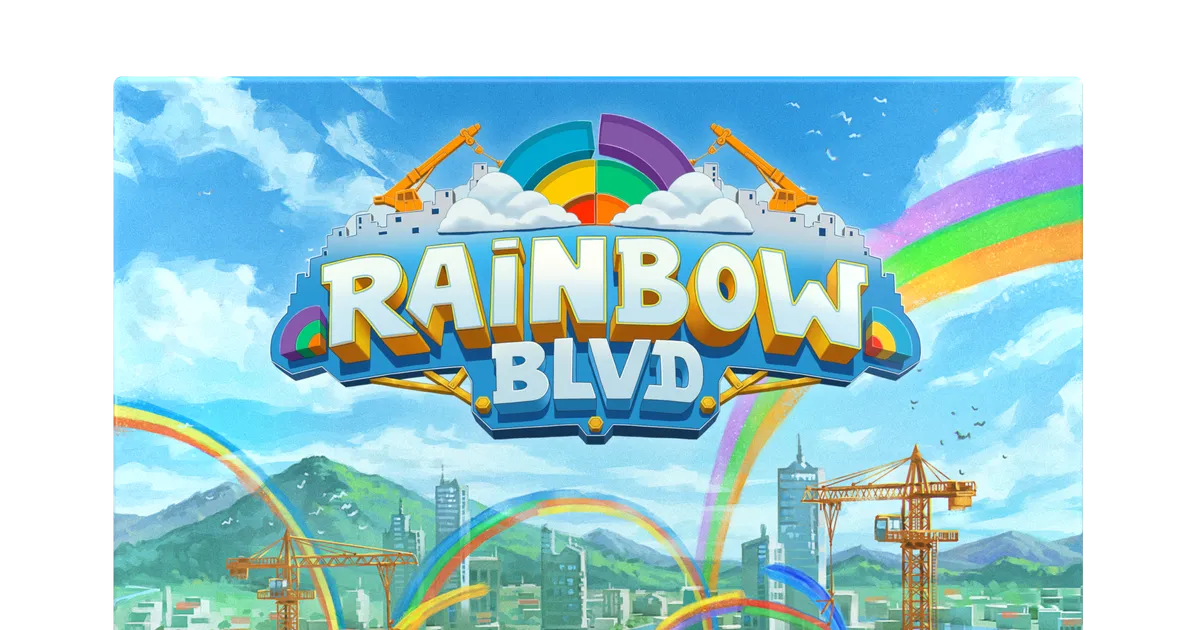
I've noticed a pattern in how I judge games before I've even touched them, and it's not a flattering one. Something looks warm or playful, and some part of my brain quietly files it under "not serious." As if charm and depth can't occupy the same box. I don't actually believe that when I stop to think about it, but I catch myself acting on it anyway, and Rainbow Blvd. is the kind of game that calls the habit out. On its face: you're an animal architect in the city of Hopewell Springs, building three dimensional rainbows, competing to become Head Architect. Read that sentence back and tell me it doesn't sound like it belongs on a picture book shelf. Fine. Let that sit for a second, and then look at what's actually running underneath it. You're managing a hand of cards. You're working a time track, so the order and pace of your decisions compound as the game goes on. You're fulfilling city plans while also chasing private contracts whose value isn't fixed, it depends on what everyone else at the table is doing. And then there's the detail that actually got me thinking: color company lobbyists are working the board in real time, pushing up the value of specific hues while you play. Your choices aren't worth what you decide they're worth. Other people's interests are quietly rewriting the board's economy while you're mid game. That's not a decoration on top of a light family game. That's a real question about making decisions under uncertainty, dressed in bright colors so it doesn't announce itself as one. The specs: 1 to 4 players. 30 to 75 minutes. Age 10 and up. Mechanisms include action selection, hand management, a time track, and set collection. I keep coming back to that age rating. There's a difference between a game that's simple and a game that's genuinely open to a ten year old without insulting the adult sitting across from them. That's a narrower target than it sounds, and most studios miss it in one direction or the other. On knowing who built it I try to be careful about leaning on someone's résumé as a stand in for judgment. A good title at a good company tells you what someone was trusted with, not what they'll make when the trust is entirely their own. Those are different questions, and it's easy to blur them if you're not paying attention. Still, a résumé isn't nothing either, it's just evidence, not a verdict. Scott Morris runs Steelwing Games, known on BoardGameGeek as Tox. Before this he was VP of Business Development at Arcane Wonders and President of Passport Game Studios. For the past four years, Scott has been with Lucky Duck Games working as the Global Brand Director and general dude that gets things done. Those jobs don't run on charisma alone. They require actually knowing, from the inside, what separates a design that plays well in a pitch meeting from one that survives forty plays at a real table. When someone with that vantage spends years watching how games succeed and fail from the business side, and then chooses to go build his own rather than keep steering other people's, I find myself wanting to know what he saw that made that trade worth it. I don't know the answer. But it's the kind of question that makes me want to keep watching. Where that leaves me I haven't played it. You haven't either. I'm not going to dress up a hunch as a verdict just because it's a well reasoned hunch. What I'll say honestly is that the pieces here, the mechanics, the age design, the person behind it, add up to more reasons to pay attention than most things that land in my feed, and that's really all I'm claiming. If you'd rather be ready for the campaign than catch it after the fact, the newsletter at SteelwingGames.com is where that starts. Nothing more complicated than that. I'll write about the campaign here once it's live. By Norman, BigGame on BGG Tabletop. Photography. Philosophy. The spaces where all three live.