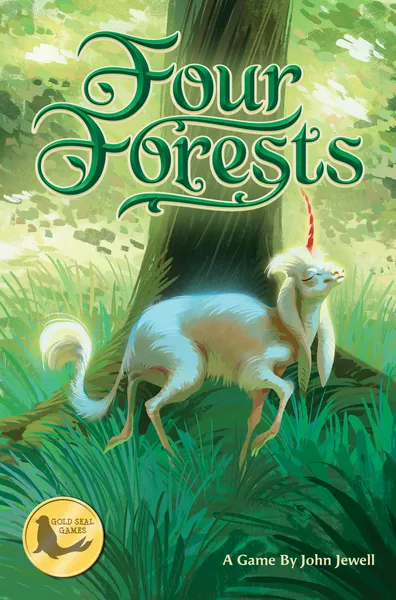
I played Four Forests alone this week, both hands, which is a strange thing to admit about a game whose entire middle is built on passing something to somebody else. Each round you cultivate a card into your own little habitat, you vote a card face down toward one of the four creatures to push its appeal up or down, you pass a card to your neighbor and take one from the other side, and then you prune, discarding something from what's left. Do that four times, your hand growing by one card each round, and you score whatever's sitting in your habitat and your hand against whichever creatures actually showed up wanting it. I ran both seats myself, dealt two hands, made two sets of choices, and passed cards from one side of the table to the other side of the same table, which is to say I passed them to myself. It worked, in the sense that I learned the game. I understand the shape of it now, the tension between holding a card because your own habitat wants it and letting it go because you can feel your neighbor's votes tilting the creatures somewhere you don't want them to go. But there was a specific kind of nothing sitting right in the center of the pollinate step, the part of the game that's supposed to be the whole point, where you receive a card you didn't choose and have to decide what to do with a decision someone else made. When I passed a card to myself, there was no unknown in it. I already knew what was coming because I was the one who sent it. I keep turning over what that actually removes. It isn't the mechanics, the phases all still function, the math of the game still resolves the same way it would with four strangers around a table. What's missing is closer to what philosophers mean when they talk about the Other as genuinely other, not just an obstacle or a variable to plan around but a will that isn't yours and can't be fully modeled by yours no matter how carefully you try. A hand of cards passed from a real person carries a little sediment of their actual reasoning, their own private math about what they needed and what they could afford to give up, and you receive that sediment along with the cardboard. A hand passed from yourself to yourself carries nothing but your own reasoning twice. It's not a second opinion. It's an echo wearing a second opinion's clothes. I don't think the solo run was wasted. Rehearsing something alone before you bring it to other people isn't pretending the other people aren't necessary, it's usually the opposite, it's taking them seriously enough to not want to fumble the rules explanation in front of them. A musician runs both parts of a duet alone before the second player ever shows up, not because the other part doesn't matter but because it matters too much to get wrong live. I think I was doing something like that. Learning where my own hands go so that when someone else's hands are the ones I don't control, I can actually pay attention to what they're choosing instead of what the rulebook says. The habitat cards are still laid out on my table from the solo run, four little rows of forest that never had to answer to anyone but me. By Norman, BigGame, BGG Tabletop. Photography. Philosophy. The spaces where they all live.
Install this app for quicker access from your home screen.
Game News
Sign in
Game Shelf
Roll for fun, seriously.
Session recaps, convention trips, and a running record of every game played — now I can track how I waste both time and money!!
On the shelf
My Game Collection
The Game Steward
Silas
Good evening. What are we feeling like this evening?
You vs. the Crowd
Your Hidden Gems
Not Your Thing
Head to Head
Compare Collections
Enter a BoardGameGeek username to see the overlap with this shelf — what you both own, and what they have that's worth a look.
Buy & sell
Games In & Out
On the road
Conventions
Coming up
Find a Convention Near You
Search live convention listings via Tabletop.Events — results link straight back to the real event page, and any of them can be added to your list above with one click.
or
The record
Games Played
Not on your shelf yet — search BGG to log it as "played, not owned":
Most Played
Played, Not Owned
Play Activity
Last 12 months, regardless of the filters above.
Less
0
1
2–3
4–5
6+
More
Games Played by Month
Head-to-head
Win % by game
Compare periods
Pick any year, or a year + month, on each side.
vs
Period A
Period B
In depth
Reviews
Want to buy
Wishlist
From BoardGameGeek
Trending Right Now
Your shelf, by the numbers
Insights
Cost per Play
Purchase price divided by sessions logged — lowest cost per play first.
Weight vs. Plays
Does complexity predict how often a game hits the table?
Weight Distribution
How your shelf spreads across BGG's 1–5 complexity scale.
Top Mechanics & Categories
The most common mechanics and categories across your collection.
Publication Timeline
When the games on your shelf were originally published, by decade.
Player-Count Coverage
How many owned games support each player count, versus how often you've actually played at that count.
Games that support itSessions actually played
Who's been at the table
Players
Game Nights
Pick a date, invite friends, see who's in — before the game, not just the record of it afterward.
Friend Activity
Recent plays and reviews from friends who've made their collection public, plus any belt you've won or lost.
Your Achievements
Sharing
Shows next to your name in Friends, the Leaderboard, and the Activity feed.
Make your collection browsable by anyone with the link — sessions, reviews, and everything else you track stays visible read-only, exactly like Norman's public shelf.
Sessions, belts, and trophies from your week, sent once a week. Skipped automatically on a quiet week — no empty emails.
A friend request, a trophy, a game night invite, or an RSVP to a night you're hosting. Nothing else pings you.
Friends
Link an account so you can tag them directly in a session, instead of just typing their name.
Requests waiting on you
Pending — sent by you
Your friends
No friends linked yet — send a request to tag them in sessions and start a rivalry.
Belts
Who currently holds bragging rights at each game you've played against a linked friend.
Leaderboard
How you stack up against everyone you've linked as a friend.
Site
Visible to you alone.
—
Registered users
Notes from the shelf
Blog
10 games · 10 plays each
10x10 Challenge
Support your FLGS
Game Stores
Anywhere else
Find Stores Near You
Free search via OpenStreetMap — coverage depends on how well a shop is tagged there, so it's a helpful complement to the picks above, not a complete directory.
or
Owner only
Piece ID
Photograph a game's component list to teach it, or photograph a stray piece to find out which game it's from. Runs through Claude, only visible when you're signed in.
Teach a game
What is this?
Comparing against the whole library
Games taught so far
Check the games that are actually out today to scope "What is this?" to just those — cheaper and faster than comparing against everything you've ever taught. Leave all unchecked to compare against the whole library.
Loading…
About this shelf
Hi, I'm Norman — this is my personal board game collection tracker: every game I own, every session I've logged, and honest reviews as I write them. I built it to keep an accurate record for myself, and to give other hobbyists something real to compare notes against.
0
Games owned
0
Sessions logged
0
Plays this year
Are you sure?
Tonight's Pick
What should we play?
Ready when you are
Scan Shelf
Photograph up to 4 shelf photos and Claude will list every game it can read from the box art and spines. Nothing gets added until you confirm each one below.
Scan Barcode
Point your camera at the box's barcode. This looks up the retail product name, then searches BGG for a match -- you'll still pick the right one.
Your Game Shelf, Fingerprinted
Game DNA
Nice win
Send a trophy?
A shareable card commemorating the win — they'll get their own copy too.
Game Night
What should we play?
Games you both own.
Welcome to the shelf
Let's get your collection started
Track what you own, log every session, and keep score against friends. Two ways to fill your shelf: