Pondscape and the Trouble With Creeping Things
2026-08-18
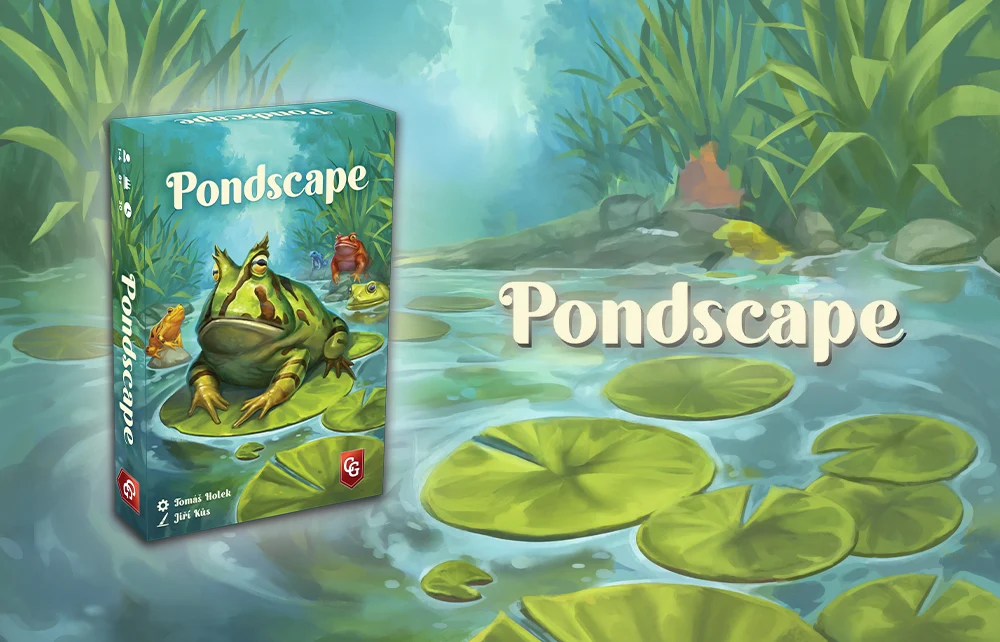
I keep coming back to Pondscape, and I keep leaving it the same way, having enjoyed every minute of it and understood almost none of it. It's a lovely little game about frogs. You're building a pond, card by card, and each species that lands in it wants something different from you, in the way that anything alive tends to want something different from you if you look closely enough. The Panamanian Golden Frog cares about what you've tucked away under your food supply. The Desert Rain Frog doesn't care about your careful clusters at all, it just wants to sit where it sits and hand you points for the privilege. Somewhere in the middle of the table there's a jumper frog that everyone is nudging around after insects, and whatever it catches becomes a shared prize you're all quietly competing over without ever quite agreeing to. Five beetles times two tucked cards is ten points, and I know that, I can say it out loud at the table, and it still doesn't stop me from ending nearly every game having built a pond that looks lovely and scores like a shrug. I've decided this isn't really about the game. Or it is about the game, but the game is standing in for something a little larger, which is that I seem to be constitutionally bad at herpetological games specifically. Not board games generally. Herpetological ones. Give me a game about castles or trade routes or building a train line across a continent and I can usually find the shape of the strategy inside a session or two. Give me one about creatures that creep and hop and burrow and I go soft in the head, charmed into playing for the vibe of it instead of the win. Which sent me down a small etymological hole this week, because I wanted to know if I was even using the word right. Herpetology comes from the Greek herpeton, meaning a creeping thing, from herpein, to creep. The field, as it's practiced now, covers reptiles and amphibians both, which means it technically covers frogs even though a frog doesn't creep so much as launch itself violently across a pond in a way that would get it disqualified from most creeping-related activities. The word was coined for one kind of movement and then, over a couple of centuries, stretched to hold a whole category of cold-blooded life that doesn't all move the same way at all. Snakes creep. Salamanders more or less creep. Frogs jump, sometimes spectacularly, and the discipline just absorbed them anyway because the alternative was drawing a much less useful line between "things that creep" and "things that are creep-adjacent." I like that the word outgrew its own root and nobody bothered to rename it. It still says creeping thing on the label while half of what it studies is doing something else entirely. I think that's close to what keeps happening to me at the Pondscape table. I sit down thinking I understand what kind of game this is, something gentle, something about frogs and food and tucking cards, and by the third round I'm doing arithmetic I didn't sign up for, chasing a jumper frog I don't control, watching someone else's Desert Rain Frog sit smugly in its one perfect square. The label undersold what was actually going to be asked of me. It usually does. My eldest son actually works in herpetology, which makes all of this a little more embarrassing than it would otherwise be. He's spent real years of his life on snakes and frogs, the kind of dedication where you stop being able to explain your job at a party without people's eyes glazing over halfway through. He clearly got it from his mother. Frogs just don't click with me, at least not across a game table, and there's something almost funny about raising someone who can rattle off a species by the shape of its toe pads while I'm still squinting at my own pond wondering why I'm losing to a rain frog that hasn't moved all game. I'll play it again. I always do. I just expect to keep losing to something that moves in a way its own name never quite accounted for.