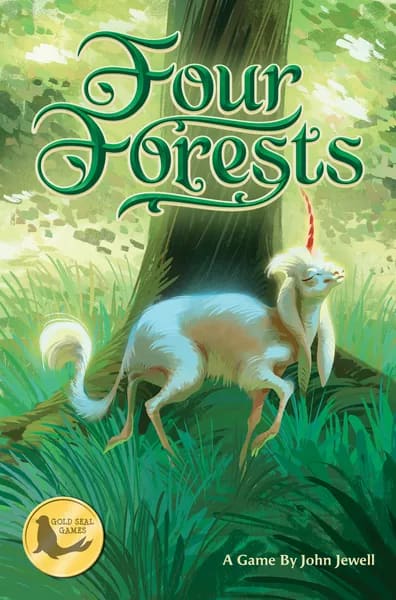
The Hand You Already Know...
I played Four Forests alone this week, both hands, which is a strange thing to admit about a game whose entire middle is built on passing something to somebody else. Each round you cultivate a card into your own little habitat, you vote a card face down toward one of the four creatures to push its appeal up or down, you pass a card to your neighbor and take one from the other side, and then you prune, discarding something from what's left. Do that four times, your hand growing by one card each round, and you score whatever's sitting in your habitat and your hand against whichever creatures actually showed up wanting it. I ran both seats myself, dealt two hands, made two sets of choices, and passed cards from one side of the table to the other side of the same table, which is to say I passed them to myself.
It worked, in the sense that I learned the game. I understand the shape of it now, the tension between holding a card because your own habitat wants it and letting it go because you can feel your neighbor's votes tilting the creatures somewhere you don't want them to go. But there was a specific kind of nothing sitting right in the center of the pollinate step, the part of the game that's supposed to be the whole point, where you receive a card you didn't choose and have to decide what to do with a decision someone else made. When I passed a card to myself, there was no unknown in it. I already knew what was coming because I was the one who sent it.
I keep turning over what that actually removes. It isn't the mechanics, the phases all still function, the math of the game still resolves the same way it would with four strangers around a table. What's missing is closer to what philosophers mean when they talk about the Other as genuinely other, not just an obstacle or a variable to plan around but a will that isn't yours and can't be fully modeled by yours no matter how carefully you try. A hand of cards passed from a real person carries a little sediment of their actual reasoning, their own private math about what they needed and what they could afford to give up, and you receive that sediment along with the cardboard. A hand passed from yourself to yourself carries nothing but your own reasoning twice. It's not a second opinion. It's an echo wearing a second opinion's clothes.
I don't think the solo run was wasted. Rehearsing something alone before you bring it to other people isn't pretending the other people aren't necessary, it's usually the opposite, it's taking them seriously enough to not want to fumble the rules explanation in front of them. A musician runs both parts of a duet alone before the second player ever shows up, not because the other part doesn't matter but because it matters too much to get wrong live. I think I was doing something like that. Learning where my own hands go so that when someone else's hands are the ones I don't control, I can actually pay attention to what they're choosing instead of what the rulebook says.
The habitat cards are still laid out on my table from the solo run, four little rows of forest that never had to answer to anyone but me.
By Norman, BigGame, BGG Tabletop. Photography. Philosophy. The spaces where they all live.